
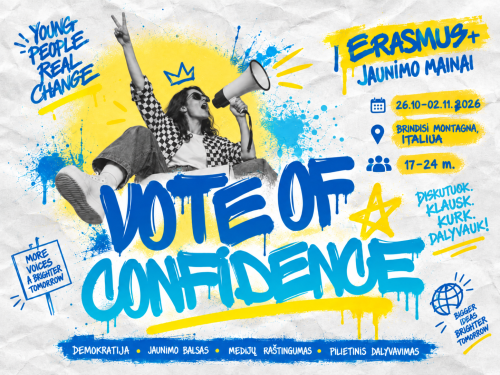
What is Vote of Confidence?
Vote of Confidence is an international Erasmus+ youth exchange taking place in Brindisi Montagna, Southern Italy, from 26 October to 2 November 2026, bringing together young people aged 17–24 from Europe and beyond.
Each national group consists of 9 people, including one or two group leaders depending on the specific needs of the group.
The core idea of the project is simple: democracy is not a spectator sport. It only works when people ask questions, discuss, verify information, listen to different perspectives, and take part in decisions that affect their lives.
Vote of Confidence invites young people to explore who holds power, whose voices are heard, and how we can take part in shaping our communities and society.
Who actually makes the decisions?
Every day, we are affected by decisions made at many different levels – from our local communities to national and European politics. But we do not always stop to think about how those decisions are made, who gets involved, and what opportunities we have to participate ourselves.
Why do some young people vote while others do not? What happens when people lose trust in democratic institutions? Is voting in elections the only way to participate?
Vote of Confidence explores these questions in a practical way – not by memorising political theory, but through discussion, simulations, analysis of real-life situations, and experimenting with different forms of participation.
Democracy as a learning method
In this project, democracy is not just something we talk about.
It becomes part of the learning process itself.
Participants make decisions in groups, discuss, argue their points, listen to different opinions, create campaigns, analyse information, and practise not only expressing their own position, but also genuinely hearing other people.
The programme includes election simulations, debates, campaign creation, media analysis, creative workshops, discussions, intercultural activities, and practical group tasks.
There is no need to be a political expert. The organisers make this very clear: no long lectures, no empty promises, and no expectation that participants already know everything about politics.
Understanding how democracy works
One part of the programme focuses on the mechanisms of democracy itself. Participants will explore democratic principles, rights and responsibilities, and look at how elections and democratic institutions work in practice.
The programme includes an election simulation, during which participants will create campaigns, debate, vote, and later reflect on what influenced their decisions.
This allows participants to understand elections not only as a theoretical process, but also to experience how messages are created, how opinions are shaped, and how people make choices.
The information that shapes our opinions
A major part of the project focuses on media literacy, misinformation, and manipulation. Every day, we are exposed to huge amounts of information through social media, news platforms, influencers, advertising, and the people around us. But not all information is equally reliable.
Participants will explore how information shapes opinions, how to recognise manipulation, how to verify sources, and how to distinguish between a fact, an interpretation, and a deliberately misleading message.
The programme includes activities such as Behind the Screen, Fake, Fact or Manipulation?, news analysis, and practical information research and verification.
Disagreeing does not mean becoming enemies
Democracy inevitably means that people will not always agree. That is why one of the important themes of the project is how to discuss differences without turning disagreement into hostility.
Participants will practise building arguments, listening to other people, asking questions, and challenging their own assumptions. The project intentionally creates space for different views, disagreement, and debate.
The aim is not to make everyone think the same way. The aim is to learn how to keep talking even when our positions are different.
Democracy does not end at the ballot box
One of the key questions of the project is what young people can do between elections. Voting is one form of democratic participation, but it is certainly not the only one.
Participants will explore activism, volunteering, petitions, youth councils, community initiatives, and other ways of contributing to their surroundings. The programme includes a session called Democracy Beyond Voting, followed by activities where participants look at real local issues and ask the question: What can we do locally?
This helps connect the abstract idea of civic participation with concrete actions that can be taken in a school, university, town, or local community.
From information consumer to content creator
The project does not stop at analysing content created by other people. Participants will also create content themselves.
The programme includes stages of research, verification, communication, and video creation under the theme Research. Verify. Create., followed by filming, editing, and presenting the final results.
This gives participants a practical understanding of how many decisions sit behind every public message: what we choose to show, what we leave out, which sources we use, and how the format we choose can influence an audience.
A non-formal education project
Vote of Confidence is not a traditional training course or a week of lectures. The programme uses games, simulations, debates, team missions, campaign creation, media analysis, creative tasks, filming, intercultural activities, and reflection.
The first days focus strongly on getting to know each other, team building, and introducing Erasmus+ and Youthpass. Later, the programme moves towards democracy, elections, media, civic participation, and practical action.
At the end of the project, participants take part in final reflection, peer feedback, the Youthpass process, and an overall evaluation of the experience.
The organisers also emphasise participant responsibility: being on time, respecting others, following accommodation rules, cleaning up after yourself, and actively taking part in the sessions. The project has two goals – learning and having a good time – but it is not designed only for the second one.
Southern Italy and Matera
The project takes place in Brindisi Montagna, a small medieval village in the Basilicata region of Southern Italy.
Participants will stay at Basilicata al Volo, a youth accommodation surrounded by the Grancia Forest, with shared spaces, a garden, and room for the international group to live and work together.
Despite being in Southern Italy, Brindisi Montagna is located in a mountainous area, so late October and early November can be fairly cool, especially in the evenings.
The programme also includes a visit to Matera, giving participants the opportunity to experience more of the cultural context of the Basilicata region.
From questions to action
The main outcome of the project is not simply gaining more knowledge about democratic institutions or elections.
The aim is for young people to better understand how their own opinions are shaped, how to verify information, how to discuss constructively, and what practical ways they have to take part in decisions that matter to them. The project invites participants to come with questions, bring their own perspective, and be willing to challenge their own assumptions.
The goal is to leave not only with international friendships, but also with practical tools and greater confidence in your ability to make your voice heard.
Who can participate?
The project is for young people aged 17–24.
It is especially suitable for people who are only beginning to take an interest in democratic and civic life, who want to discover new ways to participate, who are interested in activism, or who are simply curious and want to better understand what is happening around them. There is no need to already be politically active or to have previous experience.
Much more important is the willingness to ask questions, discuss, listen even when you disagree, meet young people from other countries, and actively participate in the full programme.
The project is carried out in English, so participants need a level of English that allows them to communicate in an international group and take part in discussions. Perfect English is not the goal.
Project partnership
Vote of Confidence brings together young people from Europe and beyond for an international week in Southern Italy.
🇮🇹 The project takes place in Brindisi Montagna, Basilicata, Italy
🇱🇹 VšĮ Anglų kalbos studija is the Lithuanian partner and sending organisation
Each national group consists of 9 people, including one or two group leaders depending on the needs of the group.
The project is funded by the European Union through the Erasmus+ programme.