
1. Home
  2. Camps
  3. Halloween camp 2025

Halloween camp 2025

Our spookiest camp this year!
90 EUR
SOLD OUT
Halloween camp 2025
Early bird price 90 EUR
Nov 2-5
Ages 11-17
Table of contents

Halloween Camp 

REGISTER

About the camp

Check out last year's camp videos here.

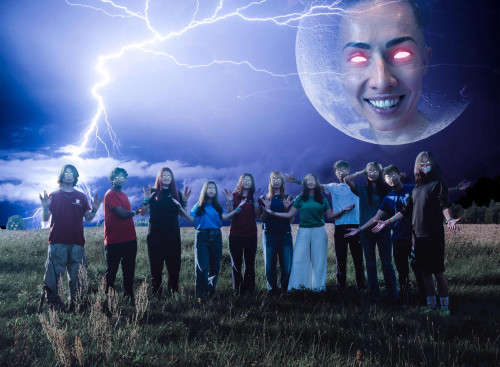
Join us in the SPOOKIEST camp this year! If you're 11 - 17 years old, we welcome you to our AKS campsite 3 where we will celebrate the upcoming Halloween all together and will spend four days talking, screaming at zombies, watching movies, building new friendships and carving pumpkins! All activities will be in English. 

Since it will be autumn outside with a lot of rain (hopefully not too much), we will not sleep in tents as always, but in the house, therefore, the number of places is very limited.  AKS Campsite 3 can take in up to 45 campers. So, the  sooner you register, the more chance that you fit!

Price 

Early bookings 90 EUR, last weeks before the camp (from Oct 19) 110 EUR, meals included. 

Arrival

Participants arrive by themselves. If you do not have a ride, write to us, we will try to cooperate you with other campers.

You can arrive on Sunday, Nov 2 from 18:30 or on Monday from the very morning.

The camp ends on Wednesday, Nov 5, by 12:00. 

Accommodation 

On AKS stovyklavietė 3 (Campsite 3) in a haunted... I mean, heated house with toilets inside, hot water, and electricity. Participants have to bring their own bedding (mattress, sleeping bag or a duvet, socks (several pairs) also, hats wouldn’t hurt). It will not be cold inside, but we will go outside at times, so get dressed accordingly.

How to register

You can register by clicking HERE. 

After the registration, please make a deposit of 20 EUR for the camp (it is non-refundable); upon receiving the deposit, we will add you to the list of participants.

The very last week before the camp we will send you a Camp Agreement, a Parent Consent Form, a List of Rules - please bring the signed documents to the camp or send them scanned via email. We will provide you with the list of things to bring and the directions to help you find the campsite.

You can pay the remainder of the cost by bank transfer before the camp or by cash once you arrive.

We are happy to answer any of your questions in any form – simply ask!

Spooky Camp Program (PRELIMINARY)

Sunday, Nov 2:

18:30 Arrival of participants, unpacking, settling in. Attention: you will be kindly greeted by The Witch, so be ready. 

20:30 Opening circle with hot blood (or perhaps tea) 

21:30 Team building activities 

22:30 Story telling activity - sharing your fears  

23:00 Evening circle  

Monday, Nov 3:

09:00 Wake up (if you dare) 

09:30 Breakfast 

10:15 Morning circle 

11:00 Team building games with the newly arrived ones

12:00 The Witch in history, movies, cartoons and today's life (seminar plus workshop)

14:00 Lunch 

15:00 Magic - numerology, palmology etc (seminar and practical part) 

16:00 Surprise Activity! (made by YOU) 

17:00 Lucid Dreaming (seminar/workshop)-

18:30 Dinner and Cleaning time 

20:00 Halloween Movie and Discussion 

22:00 Evening Circle 

Tuesday, Nov 4:

09:00 Wake up 

09:30 Morning circle 

10:00 Breakfast  

11:00 Halloween Fears workshop (Photoshoot based) 

12:30 Vampires: Introduction 

14:00 Lunch

15:00 Number 13: how and why  

16:00 Paranormal Activity 

17:45 Seminar: How they celebrate Halloween abroad 

19:00 Dinner and Cleaning time

20:30 Night hike

22:00 Evening Circle 

Wednesday, Nov 5:

09:00 Wake up 

09:30 Morning circle 

10:00 Breakfast 

10:30 Magic Words - spells, language programming, proverbs

11:15 Cleaning Time 

12:00 Good Bye (Tears and turning into Zombies Optional) 


YOU MAY LEAVE YOUR FEEDBACK HERE

Frequently asked questions

How good does my child's English need to be to join an AKS camp?
Perfect English is definitely not required. At our camps, English is not a school subject and nobody is grading it – it becomes a tool for real communication. Participants need it to understand a game, ask a leader a question, explain an idea or communicate with an international team member. If a teenager understands some basic English and is willing to try, we usually find ways to communicate very quickly. Leaders speak clearly, demonstrate activities, use body language and adapt when something is not understood. For a child who understands virtually no English at all, however, a full week in an English-speaking environment may become constant stress rather than a positive challenge. In that case, contact us before registering and we can assess whether the camp is a good fit.
Can my child come to camp alone without knowing anyone?
Absolutely. A significant number of our campers arrive without a friend. During the first days, we deliberately help the group connect instead of expecting everyone to simply “find their people”. Leaders pay attention to who is still on the edge of the group, who finds joining in more difficult and who has not yet made a connection. Having a friend there can make the first day easier. It is certainly not a requirement for having a good week.
What age can children join an AKS residential camp?
Our summer #yoursummerinEnglish camps are generally for young people aged 11–17. Age alone, however, does not tell us whether somebody is ready. It matters whether the child has slept away from home before, whether they actually want to attend and whether they are at least a little interested in what the camp involves. If an 11-year-old has never spent a night away from family, is coming alone and does not really want to be there, the first days can be difficult. Before registering a younger participant, show them the photos, videos, rules and camp description. They should know where they are going – and agree that they want to go.
Is AKS camp suitable for shy, sensitive or neurodivergent teenagers?
Often, yes. These are actually some of the young people who can feel particularly comfortable in a camp that is not built around constant competition, noise or being the loudest person in the group. We leave room for different ways of participating, and our leaders pay attention not only to the most active teenagers but also to those quietly sitting at the edge of the group. We have experience working with autistic and other neurodivergent young people, and our summer campsite includes a quieter space where participants can step away from the group. However, neurodivergence is not one universal set of needs. If your child requires specific support, a very strict routine, individual supervision or has needs we should know about, please speak to us before registering. We would rather assess honestly whether we can provide the right environment than promise that every camp suits every child.
How do you deal with bullying and conflict?
We do not treat bullying as “just something children do” or as an unavoidable part of camp life. Leaders actively observe group dynamics and intervene when we see repeated humiliation, exclusion, name-calling or behaviour that makes somebody feel unsafe within the group. That does not mean every disagreement becomes an emergency. Teenagers also need opportunities to learn how to talk through a conflict, negotiate, apologise and deal with uncomfortable moments. Our role is to help them do that rather than pretend conflict never happens.
How do you keep participants safe at camp?
At our summer camps, there is approximately one staff member for every six participants. Leaders stay on site with the campers, an adult is on night duty, and we have first-aid supplies, fire-safety equipment and procedures for emergencies. We pay just as much attention to emotional safety: group dynamics, bullying prevention, boundaries, access to a trusted adult and making sure that neither the very quiet nor the very loud teenager disappears in the crowd.
Can participants use their phones at camp?
At our residential summer camps, phones spend most of the day taking a break from teenagers – and teenagers get a break from their phones. Devices are kept safely by the leaders and are normally returned for around half an hour in the evening. That gives participants time to message home, check what they need and share their day without turning every free moment into screen time. Parents can always contact the camp leaders if something urgent comes up. We do not limit phones because technology is “bad”. A whole week without constantly checking a screen is simply becoming a rare experience – and we think it is worth trying.
What happens if my child gets homesick and wants to leave?
Saying “I want to go home” on the first or second day does not automatically mean a child needs to be collected immediately. A new place, unfamiliar people, different routines and life away from home can be difficult even for quite independent teenagers. We first talk to the participant, try to understand what exactly is wrong and work on the actual problem – whether that means helping them connect with somebody, adjusting something practical or simply giving them time and support. We do not keep a child at camp at any cost. If the situation is not improving and camp has genuinely become distressing, we make the decision together with the family. This is also why we strongly recommend not sending a younger child to residential camp against their wishes. Camp can stretch a comfort zone; it should not begin with coercion.
Is an AKS English camp an English course?
No. That is rather the point. Participants do not spend half the day sitting with textbooks, taking grammar tests or counting how many new words they have “covered”. English is used for what language is actually meant for: communication. Activities, games, stories, instructions and conversations take place in English, so the language gradually stops feeling like a school subject and becomes a practical tool. Our aim is not to move somebody from B1 to B2 in one week. A much more realistic – and more valuable – change is when a teenager stops being afraid to speak because the sentence might not be perfect.
What does a typical day at AKS camp look like? Are participants busy all day?
We prepare a full programme, but camp is not a seven-day marathon where everyone has to be enthusiastically occupied from morning until night. A day includes group activities, smaller team challenges, creative tasks, games, time outdoors and less structured moments. Some activities are energetic; others are deliberately calm. The point is to create time and space for meaningful connections to start between people.
Where do participants sleep and what happens if the weather is bad?
At our residential summer camps, participants stay in tents at the AKS campsite. Leaders sleep nearby and an adult is on duty during the night. The campsite has electricity, hot water, showers, indoor toilets and indoor spaces that can be used for activities or shelter when necessary. Rain does not cancel camp – this is Lithuania, after all. If weather conditions become genuinely severe, however, we have indoor alternatives.
What should my child bring, and can you accommodate allergies or special diets?
Registered participants receive a detailed packing list before each camp. For our residential summer camps, this includes normal camping essentials such as suitable clothing, a sleeping bag, personal hygiene items and protection from rain, sun and insects. Meals are provided at the campsite. Allergies, intolerances and important dietary requirements must be declared during registration. We can accommodate many common dietary needs, but we are not an individual catering service and cannot create an entirely separate menu for every participant. If your child has a very restrictive diet or a serious food allergy, contact us before registering so we can discuss the situation properly.