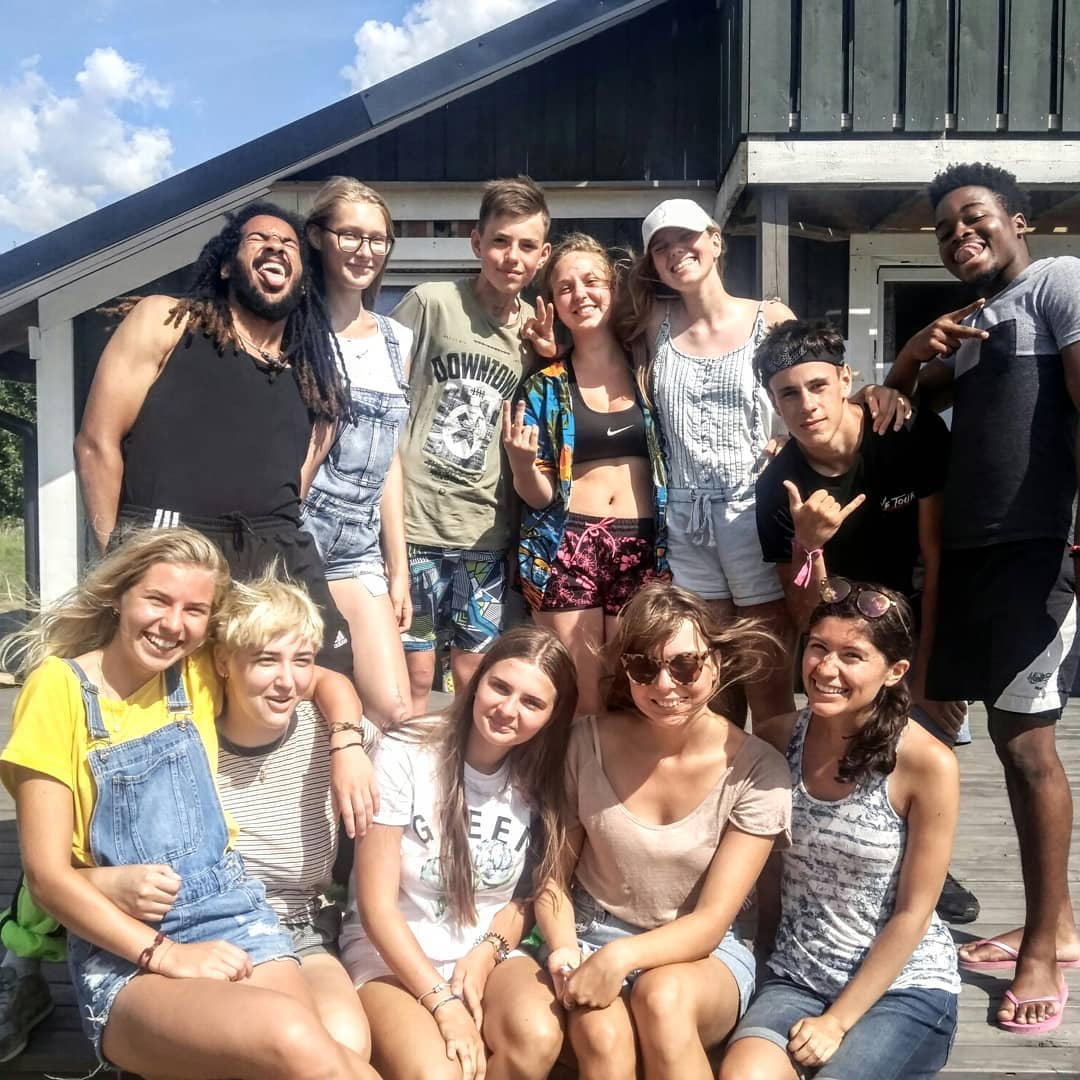

If you're planning to visit us for the very first time, make sure you look up some pictures and stories from last years' camps on our instagram anglukalbosstudija or look for #yoursummerinenglish. This will help you to get a better understanding of what to expect and calm you down, or so we hope :)
Registration for 2022 summer is over, see you next year! For now, have a look how our summer went:
About the camp
English summer camps in Anykščiai are for 11-17-year-old teenagers, most of them come from all over Lithuania and some from Latvia. All camps take place in AKS Anykščiai campsites 1, 2 and 3. Teenagers live in the tents they bring themselves. Each shift is led by international camp leaders and some Lithuanian senior teachers. Register early for the best price. Choose preliminary dates and change them later if the need be, but make sure your changes are made no later that 7 days before the planned start date!
Our campers are explaining why they keep coming back to #yoursummerinEnglish camps:
ASSISTANCE FOR FOREIGN PARTICIPANTS: If you cannot find the information you need, please contact Aurelija on +370 627 24960 for the details in English or Dovile +370 672 40433 for the details in Russian).
Locations
Anykščiai area, AKS campsite 1, 2 or 3, all rather close to each other (detached houses, far from everything). Approximately 110 km from Vilnius, 120 km from Kaunas, 75 km from Panevėžys, 20 km from Utena, 18 km from Anykščiai, 212 km from Riga. The campsites are in an area full of lakes, the nearest one a 7 minute walk away, the most spectacular - about 30 minutes away on foot. There is no shop in the proximity so bring everything you need. There are buildings on the campsite that may be used for sleeping or daily activities in case of terrible weather. Activities take place both inside and outside, depending on the weather.
Type of camp
#yoursummerinenglish camps are not physically challenging; the main element in our camps is communication without the phone or the internet, building a team and a group, creating a safe space for everyone, accepting different values and attitudes (preferred names, pronouns, LGBTQ+ friendly), establishing a close and warm relationship with camp leaders. This camp also has strict CAMP RULES that you are advised to read before booking this camp.
LANGUAGE: the main working language is English; some teachers can also communicate in Lithuanian, Russian, German, or French. Usually only one or two teachers will speak Lithuanian. PLEASE BE INFORMED THAT KIDS WITH ZERO ENGLISH WILL NOT BE ACCEPTED TO THE CAMP. Click here to check the language level for free.
LANGUAGE PRACTICE: all activities are held in English (lessons, games, projects, and events) as most camp teachers do not speak any Lithuanian. Campers are allowed to use Lithuanian, Latvian or Russian among themselves, but usually English is the only comfortable language understandable for everyone and thus most inclusive.
BUSYNESS: camp activities are based on constant communication. The main objective is to create team atmosphere, therefore children are always involved in various activities and have quite little free time. This is a TEMPLATE SCHEDULE of the camp.
ACCOMMODATION: participants live in tents that they bring themselves. The tent town is super close to the teachers' area so the kids are never left on their own. Usually at least half of each shift is made up of the participants who have already camped with us and thus know the rules very well; this helps to keep the order and security in the tent town and the camp itself. During the night time one tent in the tent town is for a teacher on duty. In case of super heavy rain everyone moves to sleep indoors. There are usually between 40 ant 70 kids in one shift.
SECURITY: In our camps, the ratio of staff to campers is 1: 6 (the usual requirement in the camp is 1:12), so we ensure that every camper will be seen and heard. We are very strict about following the rules of the camp. The majority of each shift is usually made up of returning children who understand how our camps work and are happy to help keep order. During the night, one camp leader always sleeps in a tent outside to ensure silence and emergency assistance when needed. We aim for the participants to rest well during the night, so we do not allow them to make noise for longer than specified in the schedule. All camp premises have fire alarms and fire extinguishers. Each campsite has an alarm button that directly calls the security team.
FACILITIES: in the camp you can find showers, hot water, inside toilets, and electricity.
FOOD: all meals are provided by us. If you want, you can bring your own snacks, especially to share with your new friends by the fire. Attention: if your kid has special dietary requirements, especially severe allergies for common food ingredients, please pack him or her things he or she can eat. We unfortunately do not have resources to prepare a separate tailored menu, we only provide one option (incl. meat).
DURATION: the camp opens on Sunday at 8 PM and closes on Saturday at 1 PM (pick up time from 12:00).
ARRIVAL: participants organise their transport to the camp themselves. You may come to the camp on Sunday evening, since it might be inconvenient to bring kids on Monday, which is a working day (if you choose to come on Sunday, please do that no earlier than 8pm., otherwise you'll just have to wait till we open). For international participants: coming by car the nearest bigger town is Anykščiai or Utena; coming by plane the nearest airport is Vilnius or Kaunas, after that take a local bus to Anykščiai or Utena (it will cost around 10 EUR and last approximately 3 hours. The bus tickets may be purchased online here https://www.autobusubilietai.lt/en/). Usually you will get cheaper flight tickets to Vilnius airport to compare to Kaunas airport.
PETS: there will definitely be dogs in the camp, probably two or three. They are friendly and sociable, but if you have any allergies, keep that in mind.
RULES: the use of phones, computers, or tablets is restricted in the camp. All the devices remain with the camp leaders. Camp participants are allowed to use them every evening for half an hour. In case of emergency, parents can contact the camp leaders. We ACTIVELY practice zero tolerance to bullying policy. Smoking and using any type of alcohol are strictly prohibited on the campsite and will lead to immediate sending home.
OTHER IMPORTANT DETAILS: you will need at least basic knowledge of English, a tent, a mattress, a sleeping bag, dishes, a foldable chair, warm socks and toiletries, toilet paper, insect repellent, a bag with the weirdest stuff (wigs, paint, strange clothes, accessories, glasses, etc.) for several evening activities, broad imagination and willingness not to worry about minor issues (e.g. a mosquito bite). Check out the full list of things you may need here.
FYI: If the participant would like to get a special camp T-shirt (size and color of your choice, price 20 EUR) with the participant's name on it upon arrival, please make the payment for the T-shirt together with the deposit payment (40 EUR in total). All camp leaders will be wearing the same type of T-shirts as it helps to remember each other's names much much faster! This year you can also order a onesie that keeps you warm in the evenings and protects from pesky mosquitos!
This camp is ideal for those who:
- like English language and meeting new people (many of our campers arrive solo)
- want to get to know all other campers and feel safe doing that instead of getting lost in the crowd and communicating with a closed circle of peers. AKS ensures an optimal number of participants, their integration, close collaboration with teachers, and does not tolerate bullying
- do not become upset when they have to spend a week away from home
- like spending time in the nature, are not afraid of rain, fire smoke, and animals
- love challenges, various tasks, and teamwork
- dare ask questions, are curious, love exploring and discovering new things
- are not addicted to any type of screen or would like that addiction to go away at least for a week
- see time in the camp as an amazing experience, not a week-long exile
We would like to tell something to boys who like English but are afraid of the fact that such language camps are mainly popular among girls (we had to calm down so many people who called us to ask about this that we have decided to inform you about this aspect in advance and announce this in public): no, language camps are not only popular among girls; gender distribution in most cases is 60% girls and 40% boys, so go ahead and register for the camp, you will not be the only guy!
2022 #yoursummerinenglish Camp Dates
SHIFT 1 - 06.20-06.25 Movie Time - movies, series, behind the scenes, famous directors and actors, genres, reality shows - is it always fun to be famous?
SHIFT 2 - 06.27-07.02 The Invention Of Lying - why do people lie? Does a ‘white lie’ exist? How to recognize a lie? Diplomacy or lies - where is the limit? Lie detectors, what’s going on in the lying brain, the stories of the world’s biggest liars and what if no one ever lied?
SHIFT 3 - 07.04-07.09 Girl Power - the shift dedicated for girls only: gender ‘norms’, what is ‘girly’ and what is not, what is that feminism, gender stereotypes (boys don’t cry, girls don’t become engineers), toxic masculinity, biological and social gender, fashion by gender and how this has changed in different periods of history.
SHIFT 4 - 07.11-07.16 What's Out There?- space, planets, physics and religion, life after death, the beginning and end of the universe (?), life forms, the conquest of space, science fiction.
SHIFT 5 -07.18-07.23 Real Is Beautiful - social media and real life, FOMO, internet addiction, online friendship, quarantine school, cybercrime, detachment from reality - how to get back on track?
SHIFT 6 - 07.25-07.30 Gangster Paradise- psychology of crime, notable historical crimes, judicial systems and punishments in different countries, death penalty, serial killers, escapes from prison.
SHIFT 7 - 08.01-08.06 Can't Relate - relationships with friends, parents, romantic relationships, how to start / maintain / terminate friendships after breaking them, how to recognize toxic relationships, taking responsibility in relationships, communicating with parents, the influence of authority on relationships, balanced relationships, apologizing, active listening.
SHIFT 8 - 08.08-08.13 Time Travel - How did our planet live before man, civilization, the most important inventions, future and technology of mankind.
SHIFT 9 - 08.15-08.20 Around The World - different countries, different cultures, languages and religions, traditions, family models, social divisions, democracy and dictatorship, freedom of speech, duties and responsibilities of children in different countries, food culture, art trends.
SHIFT 10 - 08.22-08.27 Your Camp Your Rules - the only shift in which neither the usual schedule nor the usual rules apply. You create the shift yourself with a little help of your camp leaders! Teamwork, leadership, putting ideas into practice - test yourself in the creative process!
Camp price depends on the time you make a booking:
! Meals and the deposit are already included in the price!
registered August 1 and later - 200 EUR
How to register?
Fill the registration form: CLICK HERE TO REGISTER
After making the reservation you will get an automated email with the summary of your booking and information about the payment (to be made in five days after the registration).
After receiving your payment, we instantly book a place for you in a certain camp shift. The last week before the camp you will receive Camp documents and once you sign them, we'll send you your QR code that will be your ticket to the camp.
You will be asked to pay the rest of the camp price by making a bank transfer last week before the camp.
We will be more than happy to answer all your questions via e-mail of phone or in person if you visit us at any of AKS branches. See you in summer!
This is a template schedule of the camp.
YOU MAY SHARE YOUR FEEDBACK HERE.