
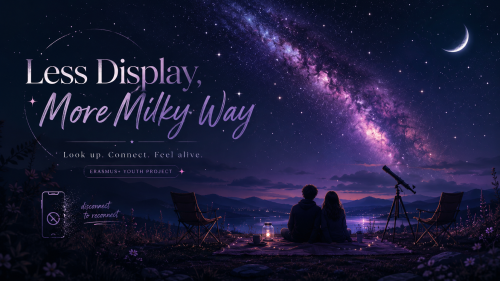
What is Less Display, More Milky Way?
Less Display, More Milky Way is an international Erasmus+ youth project in Poland combining two themes that may seem very different at first: our relationship with technology and the night sky.
The exchange invites young people to examine where their time and attention go, how FOMO, social media and constant connectivity affect everyday life, and at the same time to quite literally look up from their screens – towards the stars, space and the people around them.
This is not a project built around the idea that phones or the internet are inherently bad.
The more interesting question is: are we still controlling our technology, or is it increasingly controlling our attention and time?
Less screen, more choice
One of the main project themes is digital wellbeing and more conscious use of technology.
Participants explore how social media competes for attention, how FOMO develops and why we sometimes pick up a phone almost automatically. Activities also address time management, planning, work-life balance and practical ways of regaining more control over everyday routines.
The aim is not to complete a temporary “digital detox” and then return to exactly the same habits.
It is about noticing those habits and discovering a few realistic ways to use technology more deliberately.
What happens when the screen goes dark?
This is where the Milky Way part begins.
Stargazing and space science are more than decoration for the project title. The night sky becomes a different kind of space for attention – one that offers a dramatic contrast to the constant flow of messages, feeds and notifications.
The project connects observing the night sky with self-awareness, communicating personal needs more clearly and understanding the people around us better.
Sometimes the best alternative to another hour on a screen is simply a dark sky and a group of people willing to look at it together.
Stress, breathing and learning to stop
Emotional wellbeing is another important part of the exchange.
Participants explore what stress is, why we experience it and how we can respond to stressful or unexpected situations. The programme introduces meditation and breathing techniques that can be used in ordinary everyday situations.
This is not therapy and it does not promise that ten days will remove stress from anybody's life.
The goal is more practical: to give young people additional ways to notice their reactions and decide how they want to respond.
Where does our time actually go?
Less Display, More Milky Way also places significant emphasis on time management.
Participants look at how they organise their days, how much time they consciously choose to give to work, rest or relationships and how much can quietly disappear into screens.
The project's own materials frame the objective clearly: young people should learn not only to manage their time more effectively, but to regain a stronger sense of control over it.
Speaking with more confidence
An international exchange naturally creates opportunities to practise communication.
One of the project's objectives focuses specifically on confidence in speaking, public communication and constructive conversations. Participants use a foreign language in real situations and have opportunities to become more comfortable expressing themselves in front of others.
Perfect English is not the objective.
A much more useful outcome is reaching the point where you speak more because you are thinking less about whether every sentence is flawless.
Learning through experience
Less Display, More Milky Way is built around non-formal education and learning through practice.
The infopack emphasises experiential learning through workshops, international interaction, stargazing, meditation and other practical activities rather than passive classroom-style teaching.
The project is planned to last around ten days, plus travel days. Participants receive the detailed agenda approximately 2–3 weeks before the mobility, and the programme also includes a cultural trip to Warsaw.
An international group and everyday life together
A substantial part of the learning happens outside the formal sessions.
Participants live, eat, spend free time and deal with everyday situations alongside young people from other countries. This naturally develops communication, flexibility and intercultural understanding.
The project also explicitly emphasises respect across different nationalities, genders and sexual orientations and states that discrimination is not tolerated.
Where does the project take place?
The exchange takes place in Jedlnia-Letnisko, a small Polish town close to Radom and surrounded by nature and lakes.
Participants stay at the Pod Różami hotel in rooms for 2–5 people. Rooms include private bathrooms, linen, towels and internet access, while shared spaces and a garden are also available.
Radom is around 20 minutes away by public transport, and a separate programme trip to Warsaw is also planned.
Travel and funding
The project is funded through Erasmus+.
Travel is either organised by the partner organisations or reimbursed according to the Erasmus+ travel limits and project reimbursement rules. Exact arrangements for the Lithuanian group will be provided to selected participants.
Accommodation, meals and project activities are provided during the exchange. Participants receive three meals per day, and allergies or dietary preferences need to be communicated to the organisers in advance.
Intergalactic Alien Gala
Yes, the space theme stays until the end.
The final day includes an Intergalactic Alien Gala, with certificates, activities prepared by the different national groups, a shared dinner and an invitation to bring something that fits the intergalactic theme.
That actually sums up the project rather well: serious questions about everyday habits, some astronomy and enough weirdness to stop it becoming another generic seminar.
Preparation starts before travelling
Around 2–3 weeks before the exchange, participants receive access to an interactive Padlet.
There they can complete the mandatory pre-project survey, see the programme, meet other participants and leaders, introduce themselves, find preparation information, ask questions and join the project's communication group.
So the international group starts forming before anyone arrives in Poland.
Applications are already open
The project is planned for 8–17 October 2026.
Applications for the Lithuanian group are already open.
Project partnership
The project is coordinated by:
🇵🇱 My Future – Poland
The Lithuanian group is sent by:
🇱🇹 Anglų kalbos studija – Lithuania
The exchange will bring together young people from several Portugal, Lithuania and Poland.
The project is funded by the European Union through the Erasmus+ programme.