
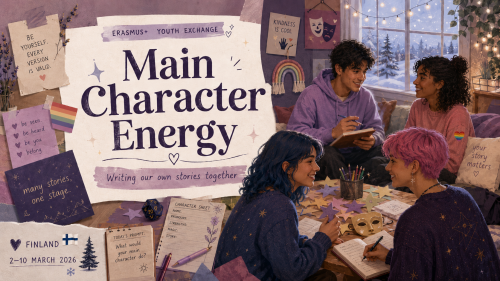
What is Main Character Energy?
Main Character Energy is an Erasmus+ Youth Exchange in Finland designed for LGBTQ+ young people aged 15–17 from three countries.
The exchange takes place at Youth Centre Villa Elba in Kokkola, a peaceful coastal setting surrounded by nature. The week combines creativity, self-exploration and community building, creating a space where young people can explore who they are and how they want to express themselves.
The title “Main Character Energy” is not really about being the centre of attention.
It is more about giving yourself permission not to remain a supporting character in your own life.
Writing our own stories together
The project's subtitle is Writing our own stories together.
That captures the idea rather well.
Every young person brings their own story and their own way of understanding identity, relationships, gender, sexuality, belonging and self-expression.
Main Character Energy does not ask participants to discover one perfect answer to “Who am I?”. Instead, it creates room to explore, experiment, change your mind and discover how other people understand themselves.
And the word together matters.
This is not an individual self-development retreat. Much of the learning happens through relationships with other people.
A space where being yourself is the starting point
The exchange is intentionally designed as a safe and affirming environment for queer young people.
Respect, openness and care for one another are central values throughout the project. Participants should be able to express themselves freely and connect with people who may share similar experiences – or completely different ones.
That can matter particularly during the teenage years, when questions about identity and belonging may feel very immediate while safe spaces to explore them are not always easy to find.
Nobody needs to prove that they are “queer enough”, have all the answers or know exactly which words describe them.
Creativity instead of lectures
Main Character Energy is based on non-formal education and creative methods.
Ideas in the project materials include creating papier-mâché masks, collaborative storytelling, theatre, improvisation and role-playing games such as Dungeons & Dragons. Other creative and interactive methods that explore identity and expression are equally welcome.
So it is entirely possible to have a serious conversation about identity in one session and spend another creating a fictional character, a mask or an imaginary world.
Sometimes it is easier to say something about yourself through a story than by answering a direct question.
The programme is not finished – on purpose
The programme is shaped collaboratively by the participating groups.
The aim is to make sure the exchange reflects the actual interests and ideas of the young people taking part rather than only what adults have decided young people “should” learn.
Each national group contributes one workshop, one warm-up or energiser and one evening programme.
The evening activity is created by the young participants themselves. It can be an intercultural evening, but it does not have to be – groups can share something they genuinely find meaningful, enjoyable or culturally relevant.
Participants therefore do not simply arrive to consume a programme - they help create it.
From meeting each other to exploring deeper questions
The beginning of the week focuses on getting to know one another through group-building activities and games.
The middle of the exchange moves into deeper exploration through workshops, discussions and creative activities connected with identity and expression.
The final days focus on reflection, sharing and celebrating what has been created and experienced together. This may include informal presentations, performances or collaborative creative outputs.
The final product is not the point.
The process of getting there is.
Identity is not a PowerPoint presentation
You can organise a lecture about identity. Main Character Energy takes a different route.
Creative methods make it possible to experiment with characters, stories and different forms of expression without immediately having to explain everything in perfect words.
A mask can explore what we show other people. A character can let us experiment with another version of ourselves. Improvisation requires us to respond without planning everything first. A role-playing game lets us temporarily see a world through somebody else's eyes.
“Who am I?” therefore becomes less like a test requiring one final answer and more like a question you are allowed to play with.
Three countries, many ways of being yourself
The project brings together queer young people from three countries.
An international group creates an opportunity to discover how differently LGBTQ+ identities, family, relationships, safety and belonging may be understood in different places.
At the same time, participants often discover how much is shared.
Intercultural learning during a Youth Exchange does not only happen through presentations about national traditions. Quite often it happens in the kitchen on day three, during a game or in a late conversation with somebody you did not know existed a week earlier.
Finnish winter and Villa Elba
The exchange takes place in Kokkola on Finland's western coast.
Early March is still distinctly wintry. Daytime temperatures are often around –5°C to +2°C and snow is usually still on the ground. The organisers plan to spend some time outdoors, although most of the programme will take place inside.
Youth Centre Villa Elba is one of Finland's eight National Youth Centres. It specialises in youth work, international programmes, education and volunteering and aims to give young people opportunities to learn in multicultural environments and discover their own strengths and abilities.
So Villa Elba is not simply a hotel where the project happens.
Youth work is what the place is built for.
Who can participate?
The exchange is designed for young people aged 15–17 who self-identify as part of the LGBTQ+ community.
Each country can bring up to eight participants and two youth leaders. At least one leader should already have worked with the participants and be involved in preparing the group before the exchange.
No professional creative skills are required. Participants do not need to know how to act, draw or play Dungeons & Dragons.
Curiosity, willingness to participate and respect for other people's identities and boundaries matter much more.
Project partnership
The exchange is hosted by:
🇫🇮 Youth Centre Villa Elba – Kokkola, Finland
The Lithuanian group is sent by:
🇱🇹 Anglų kalbos studija
The project brings together LGBTQ+ young people from three countries and is intentionally designed as a safe, affirming and creative international space.
The project is funded by the European Union through the Erasmus+ programme.