
1. Home
  2. Erasmus+
  3. Sense the World

Sense the World

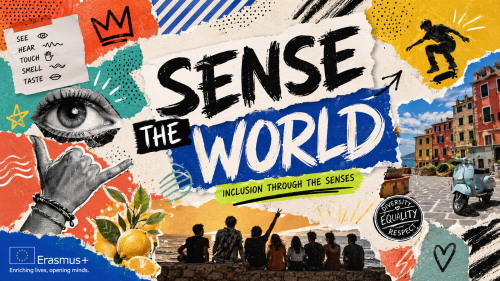
An international Erasmus+ youth exchange in Italy where inclusion and diversity are not only discussed – participants explore them through sight, sound, taste, smell, touch and movement.
Funded by EU
The group is full
Sense the World
Young people aged 16–19
7–15 September 2026
Funded by EU
Table of contents

What is Sense the World?

Sense the World is an international youth exchange in Recoaro Terme, Italy, bringing together young people aged 16–19 from six European countries.

Each national group consists of five young participants and one group leader, bringing together 30 young people and six leaders.

The project starts from a simple idea: we may live in the same world, but we do not all experience it in the same way. Our perception is shaped not only by our senses, but also by culture, memories, abilities and previous experiences.

Do we all experience the same world?

In everyday life, we rarely stop to consider that exactly the same situation may look, sound or feel completely different to someone else.

We often assume that others see, hear, feel or understand their surroundings in much the same way we do. These assumptions can create misunderstandings and invisible barriers for people whose abilities or ways of experiencing the world differ from those of the majority.

Sense the World invites participants to notice these assumptions and explore what happens when we deliberately change perspective.

The five senses become the methodology

The senses are not simply the topic of this exchange – they form the structure of the learning process itself.

Different programme days focus on different ways of experiencing the world: sight, hearing, taste and smell, touch and balance.

Participants learn through direct experience. Instead of only talking about inclusion, they see, listen, touch, smell, move and sometimes deliberately remove one of the ways they normally rely on to receive information.

Seeing the world differently

Photography and visual storytelling are used to explore sight.

Participants discover how differently people can notice the same environment, what we decide to include in an image and what our eyes automatically overlook.

Blindfolded exercises also temporarily change the way participants navigate and communicate, encouraging greater awareness of other senses and of the people around them.

Listening differently

Hearing is explored through music, shared sound-making and communication exercises.

When normal communication patterns are disrupted, participants begin to notice tone, rhythm, body language, silence and other signals more carefully.

These experiences demonstrate that effective communication is not only about speaking clearly. Listening and adapting to another person's needs are equally important.

Smell, taste and nature

Part of the programme moves into the Small Dolomites.

The “Scent Trail” combines hiking, sensory botany, smell and cooking, while the “Detective in Nature” activity invites participants to explore the natural environment through sound, footprints and details that can easily go unnoticed.

Nature therefore becomes more than a setting. It becomes a sensory learning environment.

Touch, movement and balance

The sensory approach also includes body awareness.

Team challenges, sports activities, balance exercises and a fencing-inspired workshop allow participants to explore space, coordination and confidence in movement.

These experiences create a practical starting point for thinking about different physical abilities and about how the design of an activity or environment can make participation easier for some people while unintentionally excluding others.

Inclusion you can experience

Sense the World is not about pretending that a short activity can reproduce another person's disability or life experience.

Instead, the project encourages participants to notice how often environments are designed around the needs and assumptions of the majority.

Activities lead to practical questions: Can everyone participate? Is information available in different ways? Do people have choices? Are we communicating in a way that works only for ourselves?

These sensory experiences are then connected back to diversity, accessibility, belonging and the possibility for everyone to participate fully.

Learning through experience

Sense the World is based on non-formal education rather than traditional lessons.

The programme includes photography challenges, blindfolded communication, collective music-making, cooking, storytelling, sensory hikes, team challenges and sports activities.

Structured debriefing after the activities helps participants understand not only what happened, but what the experience can teach them about inclusion, communication and accessibility.

Daily “family meetings” provide additional space for participants to reflect on learning, group dynamics and their own experience.

Italy and the Small Dolomites

The exchange takes place in Recoaro Terme in the Veneto region, close to the Small Dolomites.

Nature is integrated directly into the programme through hiking and sensory activities, while another programme day is dedicated to discovering the Veneto region itself.

Participants therefore experience not only an international group but also a specific Italian environment, culture and landscape.

From experience to everyday action

The aim of the project is not simply to learn more about the five senses.

Participants are encouraged to become more aware of different needs, strengthen empathy and communication skills and recognise practical ways of making their own environments more inclusive.

The exchange connects this learning with European Union values including human dignity, equality, non-discrimination, human rights and solidarity, translating broad principles into everyday choices about how we communicate and create opportunities for participation.

Who can participate?

Sense the World is designed for young people aged 16–19 who are interested in inclusion, diversity and international learning.

A high level of English is not required. Motivation to participate fully, communicate and experiment with new experiences matters much more.

Project partnership

Sense the World brings together partner organisations and youth groups from six European countries.

🇮🇹 The exchange takes place in Recoaro Terme, Italy
🇱🇹 Anglų kalbos studija – Lithuanian partner and sending organisation

Each country participates with five young people and one group leader.

The project is funded by the European Union through the Erasmus+ programme.


Frequently asked questions

What is an Erasmus+ Youth Exchange?
An Erasmus+ Youth Exchange brings young people from several countries together to live, learn, discuss, create and take part in a programme built around a common theme. It is not simply a trip abroad, a language course or a summer camp with an EU logo. Each project has a clear educational focus – from inclusion, mental wellbeing and nature to theatre, culture or social issues – and uses non-formal education rather than traditional classroom teaching. A large part of the learning comes from international life itself: communicating, making decisions, working in mixed groups and sharing everyday life with people whose experiences may be very different from your own.
Who can take part in AKS Erasmus+ projects?
It depends on the individual project. Some of our youth exchanges are designed for teenagers aged 13–17 or 14–17, others for young people aged 16–19 or 18–30. Every project page therefore includes its specific age range and participant profile. Age is not the only criterion. We are looking for participants who are genuinely interested in the topic, ready to take part in the full programme and understand that a Youth Exchange is a shared group experience rather than simply an inexpensive week abroad.
Do I need to speak very good English?
No. English is the common communication language in most international youth exchanges, but it is not an exam. Nobody is grading your grammar or expecting perfect sentences. You need enough English – and enough willingness – to try to understand others, ask questions, contribute to group activities and communicate in everyday situations. For many participants, an Erasmus+ project is the first time English stops feeling like a school subject and starts functioning as what it really is: a way to meet people, joke, disagree, solve problems and create something together.
Is an Erasmus+ Youth Exchange free?
Most of the main project costs are covered by Erasmus+ funding. Accommodation, meals and programme activities are normally funded, while travel costs are reimbursed up to the limit allocated to the participant's country and project. However, “funded” does not mean that any flight or travel option can be booked and automatically reimbursed. Every project has its own travel limits, rules and documentation requirements. For that reason, participants should always follow the travel instructions provided for the specific project before purchasing tickets.
How are participants selected?
When AKS sends a Lithuanian group to a partner project, we announce a separate selection process for that particular exchange. We usually ask participants to tell us about themselves, their motivation and why the topic interests them. Some projects may also include a short conversation or a preparatory meeting. We do not select people simply according to who registers fastest. Our aim is to create a group of participants who genuinely want to take part and for whom the particular project is a good match.
Can I join if I do not know anyone?
Yes. That is completely normal. Many participants do not know either their Lithuanian group or anybody from the other countries before the project begins. We prepare the national group before travelling, give participants a chance to meet one another and discuss the project, journey and expectations. The first part of a Youth Exchange is also deliberately designed to help the international group connect.
How is a Youth Exchange different from an ordinary trip abroad?
On a tourist trip, the destination is usually the main event. On a Youth Exchange, people are. You can visit Berlin, Italy or Spain without ever really getting to know somebody who lives there. During an Erasmus+ project, you share daily life, activities, conversations and challenges with people from other countries. You may return with fewer stories about “12 attractions I visited” and more stories like “I now have a friend in Slovenia, understand Czech humour and am no longer afraid to speak English.” We consider that a pretty good trade.
What does the programme look like? Are there lessons?
Usually, there are no traditional lessons. Youth Exchanges use non-formal education: group challenges, discussions, creative methods, games, reflection, practical activities, nature-based learning, theatre, photography and many other approaches depending on the topic. It is still an educational project, which means the programme matters. Erasmus+ is not a format where participants spend the day doing their own thing and only join the group for sightseeing in the evening.
Do I have to participate in the whole programme?
Yes. A Youth Exchange is one continuous group process. Of course, people get tired. Sometimes somebody needs a break, some quiet time or a lighter level of participation, and a well-designed project should have room for that. However, when you apply, the expectation is that you actually want to be part of the exchange rather than selecting only the trips and entertaining activities. If your plan is “I will skip the workshops but come for the travel”, a Youth Exchange is probably not the right format.
Are Erasmus+ projects suitable for shy, sensitive or neurodivergent young people?
They can be – sometimes extremely so – but the answer depends on both the participant and the project. AKS pays particular attention to safer and more inclusive environments and to young people who do not always find large groups easy. Our work often addresses neurodiversity, LGBTQ+ inclusion, emotional wellbeing and different ways of participating. At the same time, an international exchange still means a new country, new people, shared accommodation, a different routine and a great deal of communication. If a participant needs specific support, the best approach is to discuss it openly with us during the selection process. The goal is not to say yes to everybody at any cost, but to determine whether the particular project can genuinely be a positive experience.
Who is responsible for participants during the journey and the exchange?
Each national group travels with a group leader or leaders who support the participants throughout the mobility. The host organisation is responsible for the programme, venue, overall organisation and safety arrangements, while the sending organisation selects and prepares its national group and communicates with participants before the exchange. For projects involving minors, parental consent, emergency contacts, relevant health information and other required documents are collected before travel.
What is Youthpass?
Youthpass is the Erasmus+ youth programme's tool for recognising learning and the certificate participants receive after the project. Throughout the exchange, participants reflect on what they are actually learning: perhaps leading an activity in English for the first time, working in an international team, becoming more confident speaking in front of people, understanding their own reactions better or seeing a social issue from another perspective. Youthpass helps turn those experiences into words and recognise that “a really good week abroad” can also represent a substantial learning process.