
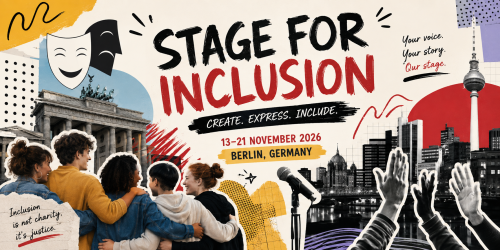
What is Stage for Inclusion?
Stage for Inclusion is an Erasmus+ youth exchange in Berlin bringing together young people from Germany, Serbia, Poland, Lithuania and North Macedonia.
The project is designed for participants aged 18–30 who are interested in creativity, inclusion, theatre, intercultural learning and youth participation.
It combines creative expression, international learning and social issues. Participants explore inclusion, diversity, stereotypes, discrimination and active participation through theatre and other non-formal education methods. The aim is to create a supportive space where young people can express themselves, learn from one another and discover creative ways to address important social questions.
When the stage becomes a place for difficult conversations
Theatre is at the centre of Stage for Inclusion, but the project is not about turning everyone into actors.
The stage creates a different way to approach experiences and questions that can be difficult to express in ordinary conversation.
Through storytelling, body language, improvisation and perspective-taking, participants transform personal experiences, emotions and social questions into shared reflection and creative action.
The project invites participants to ask what a situation looks like from another person's position, how stereotypes develop, when someone becomes excluded and what could be changed.
Inclusion beyond theory
Young people across Europe grow up in very different circumstances, and discrimination and social exclusion affect some groups more strongly than others.
The project materials specifically recognise marginalised groups including Roma youth, LGBTQI+ young people, young people from rural areas and those from low-income families. Stage for Inclusion aims to create meaningful access to international learning and a space where different voices are not merely accepted but genuinely heard.
Inclusion is therefore not only something participants discuss. It is something the group practises through how it communicates, shares space and creates opportunities for participation.
How does the exchange work?
Stage for Inclusion is based on non-formal education, participation and learning by doing.
The programme uses team-building, storytelling, guided reflection, group dialogue, improvisation, role play, forum theatre, creative group work, performance preparation, intercultural exchange and daily reflection circles.
Participants actively shape the process. They interpret the themes, create scenes, propose ideas and decide what messages they want to communicate.
Building trust before taking the stage
Before exploring discrimination, identity or personal experiences, the group first needs to become a place where people can trust one another.
The opening part of the programme therefore focuses on getting to know each other, team-building and jointly creating a safe-space agreement based on respect, inclusion and shared responsibility.
Only then does the programme move deeper into identity, stereotypes, discrimination, privilege, empathy and belonging.
Forum theatre and real-life situations
In the middle of the exchange, theatre becomes the main learning tool.
Participants work with improvisation, role play and forum theatre. In mixed international groups, they transform social experiences and real-life issues into scenes, ideas and performances.
Forum theatre allows a group not only to observe a problem but to experiment with alternatives. What might change if someone acted differently? Who has power in the situation? Who is left outside? Where could someone intervene?
The stage becomes a place to rehearse possible social change.
The final performance is not about perfect acting
Participants co-create short performances and visual elements connected to the project's themes.
A final performance and public sharing moment allows their work and messages to reach people beyond the immediate exchange group.
The objective is not a technically perfect theatre production. It is learning how creative expression can communicate a position, raise questions and start a dialogue.
Finding and using your voice
Stage for Inclusion aims to leave participants with much more than knowledge about inclusion.
Creative work strengthens communication, self-expression, body language, public speaking, teamwork, problem-solving and intercultural communication.
The project also seeks to develop empathy, confidence in one's own voice, solidarity, respect for diversity and a greater willingness to challenge stereotypes and exclusion in everyday life.
A supportive space for sensitive topics
Because the programme deals with identity, discrimination and personal experience, emotional safety is built into the project.
Participants are never expected to share more than they feel comfortable sharing. Reflection spaces are provided regularly, and organisers and group leaders remain available for individual support when someone feels overwhelmed or wants a private conversation.
This allows difficult themes to be explored without removing participants' boundaries or choice.
Five countries, five perspectives
Stage for Inclusion brings together young people from five European countries.
Working in mixed international groups allows participants to see how questions of identity, stereotypes, discrimination and belonging may look very different across societies.
At the same time, the project connects these experiences with shared European values including equality, human rights, dignity and respect for diversity.
The international group becomes an opportunity not just to present one's country, but to understand how another person interprets the same social question.
Berlin and Wannsee
The exchange takes place at Jugendherberge Berlin – Am Wannsee Youth Hostel.
The venue is located directly by the lake in Berlin's green Wannsee area, approximately 30 minutes from Berlin and Potsdam. This gives the project both a calm environment for group connection, creative work and reflection and access to one of Europe's most diverse cities.
The hostel provides activity spaces, a terrace, relaxation lawn, football field, beach-volleyball area and table tennis, as well as breakfast, lunch and dinner.
Youthpass and what happens afterwards
Reflection is part of the project throughout the exchange.
Youthpass is treated not simply as a certificate given at the end, but as a process that helps participants recognise and describe what they have learned.
After the exchange, participants are encouraged to share their experience locally, contribute to presentations, community workshops or theatre-based actions and explore future Erasmus+ and youth opportunities.
Who can participate?
Stage for Inclusion is designed for young people aged 18–30 who are interested in creativity, theatre, inclusion, intercultural learning and active participation.
It is especially relevant for participants who want to express themselves, develop confidence and communication skills, are open to diversity and want to take part in an active, respectful and participant-centred learning environment.
Previous theatre experience is not required. Curiosity, openness and willingness to participate matter much more.
Project partnership
Stage for Inclusion is coordinated and hosted by Impact Grid e.V., a Berlin-based non-profit organisation.
Impact Grid works in sustainability, social innovation, responsible management, digital responsibility and educational development. Within the project, the organisation contributes experience in project development, education and participatory learning processes.
🇩🇪 Impact Grid e.V. – project coordinator and host organisation
🇱🇹 Anglų kalbos studija – Lithuanian partner and sending organisation
The project is co-funded by the European Union.